
A new tool for understanding music
Sound Energy Aggregate is a new-to-me way of listening to music that has some serious explanatory power

If you’ve been following along here at Composer’s Notebook for awhile, you know by now I love finding ways to analyze music to understand why it has the impact that it does. In the last couple of weeks of working with a new composition teacher (hi, Damen!), I’ve been introduced to a new tool to do that: Sound Energy Aggregate (SEA).
Behind this somewhat ambiguous name is a simple idea easy to apply: if you listen through a piece of music and while listening you isolate one variable (e.g. timbre, how fast the harmony changes, perceived loudness), you chart its changes, and then do that several times, you’ll end up with a nuanced picture of a piece’s ebbings and flowings and you’ll be able to explain what makes the music intensify and relax.
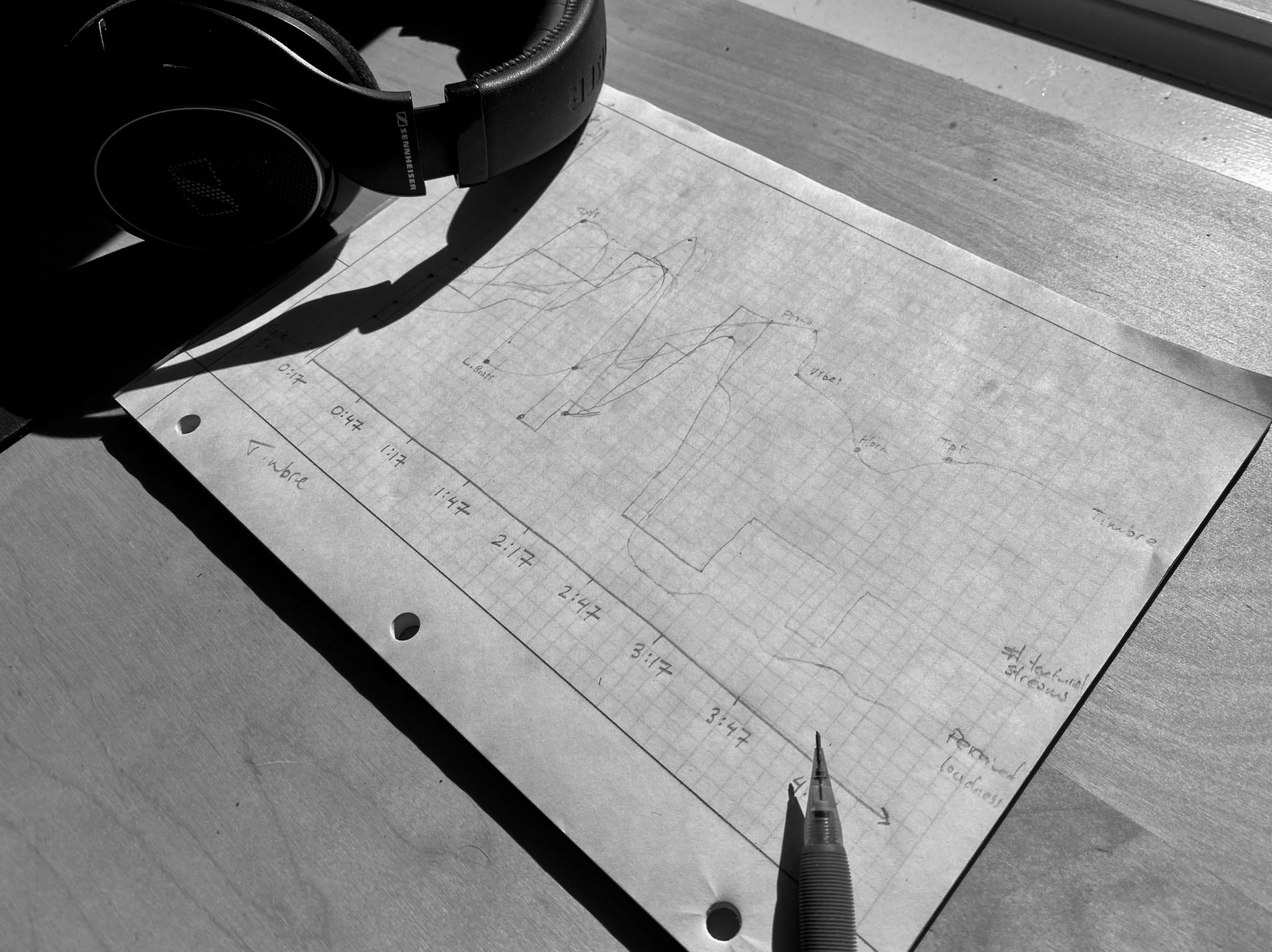
Let’s take this concept for a test drive together!
Lontano: Symphony for Wind Ensemble
I’ve long admired Michael Martin’s Lontano: Symphony for Wind Ensemble. It’s one of those pieces I think is really effective in a dramatic sense (evocative, inventive, satisfying, through-composed, not thematically driven) and I haven’t yet cracked the code.
Let’s take the first four minutes of the Symphony and apply our new tool to it. Feel free to follow along or use a piece of music you’re interested in instead.
We’ll use this recording by Jerry Junkin and the University of Texas Wind Ensemble. The relevant section is timestamped 0:17-4:17 in the video.
First, lets choose one variable to isolate and listen for. How about timbre, ranging from dark to bright? Let’s get ourselves set up with a chart and some axes.
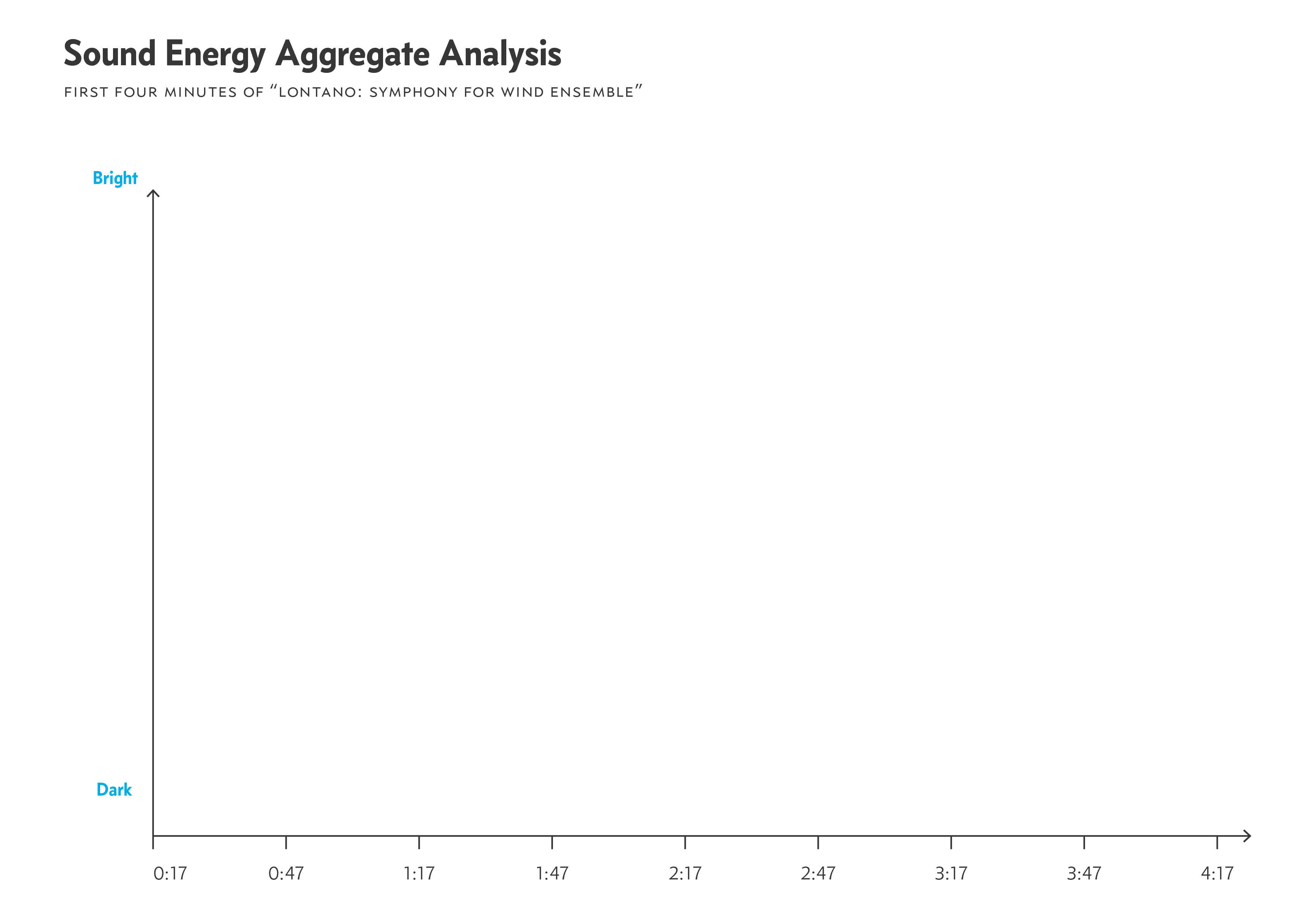
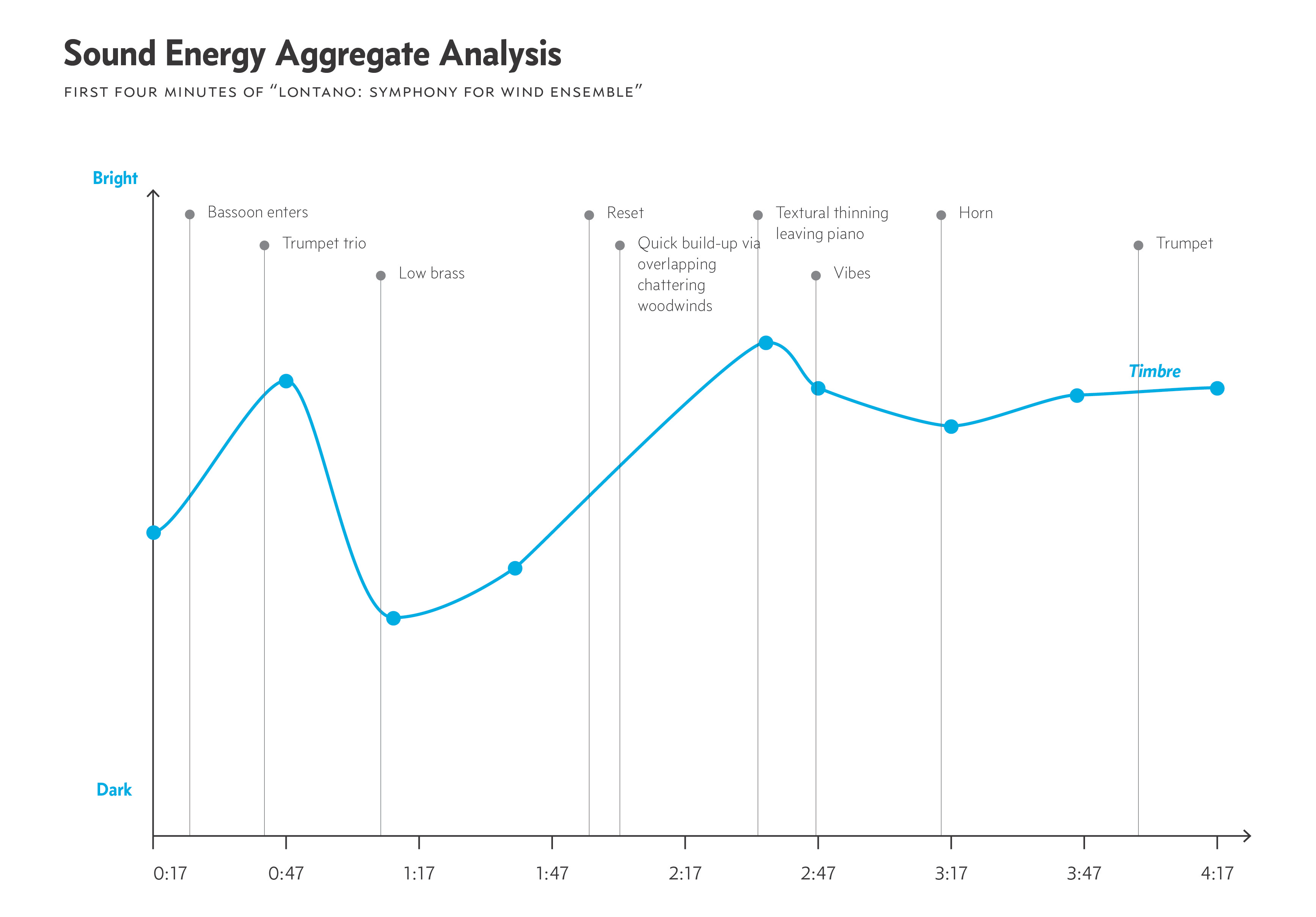
On the horizontal axis of the chart is the time from the video in 30-second intervals (starting from the downbeat at 0:17). On the vertical axis we have our variable timbre ranging from dark down low to bright up high. Now we listen, plotting out moments in the music where we hear changes (abrupt or gradual) in timbral quality.
Here were the big timbral moments I heard after an initial listen through. Then I plotted a mostly smooth line between those local landmarks roughly according to what was going on between them:
We can repeat this for other salient musical variables like perceived loudness:
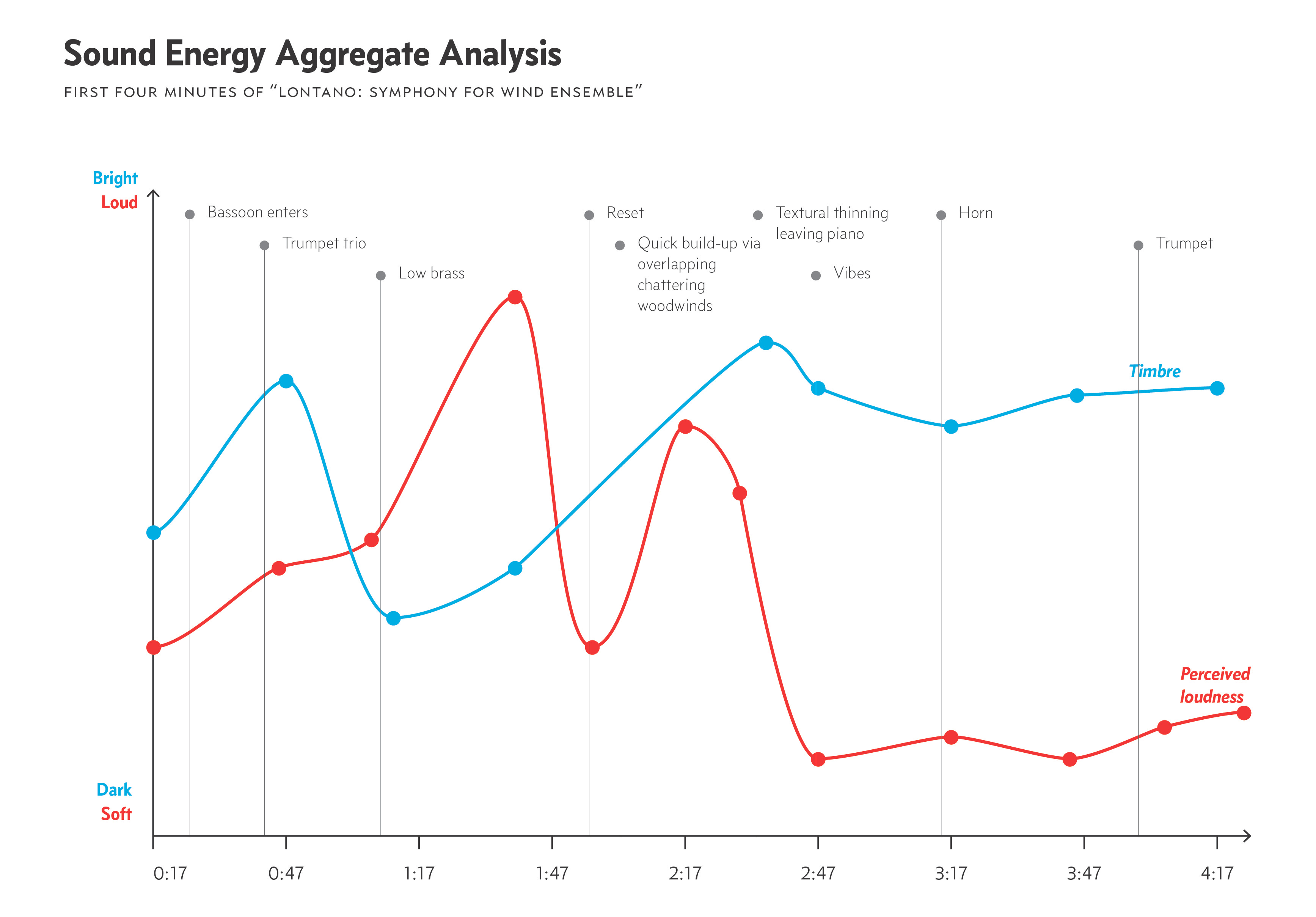
And each variable we add we gain a more complete understanding of what is going on in the music.
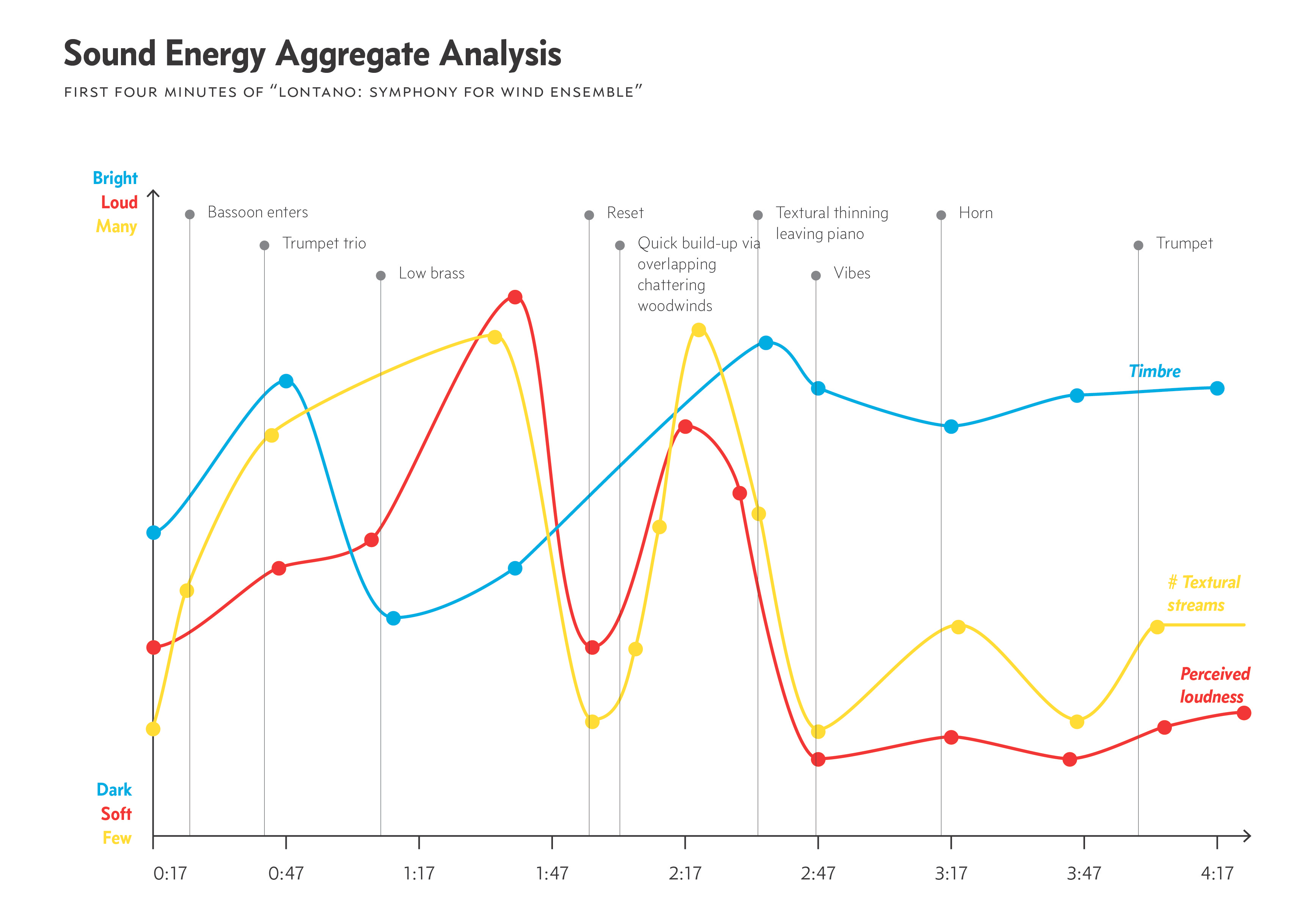
And as composers we can learn how different variables in combination produce different effects.
For this first application, I stopped my isolated listening after three variables, but there are many others you can listen for—rhythmic activity, harmonic rhythm, etc.
The composite and its takeaways
The final task is to try to draw a composite line. I’m actually not sure if this is something you do based on your overall perception of the music or based solely on a synthesis of the variables you’ve already charted.
I found it more useful to draw a composite line based on the overall impression the music leaves to see where my chosen variables do and don’t explain what I experience as an overall listener.
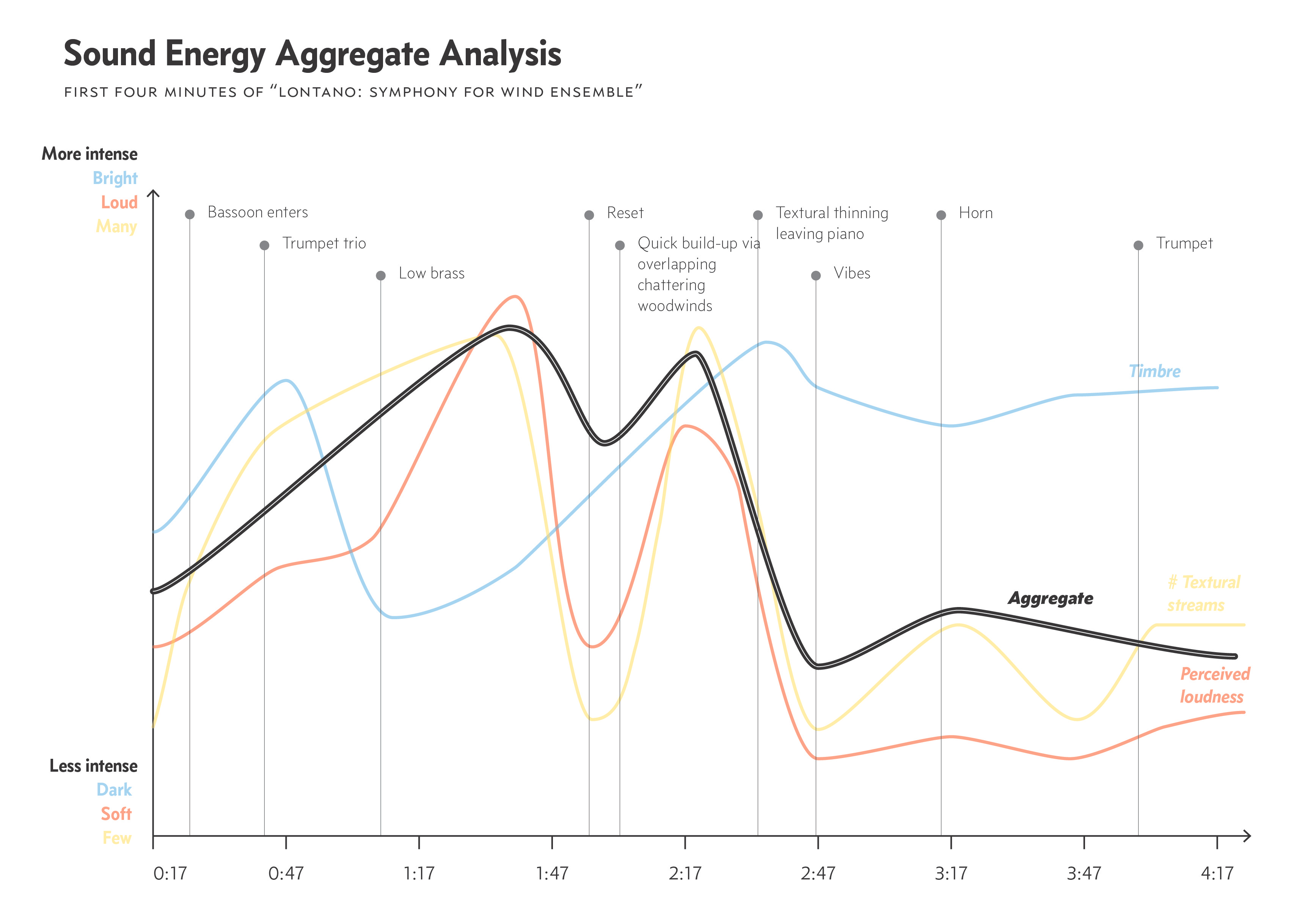
I think what most surprised me about the difference between my aggregate line and the variables was that overall I didn’t experience as much of a dip in the energy between 1:47 and 2:17 as my isolated listening might suggest. The message might be that dramatic intensity doesn’t drop just because the audible variables that produced that intensity have subsided somewhat. In other words, there is something of a hangover effect after a climax that lends the music after it energy it wouldn’t otherwise have. For a direct illustration of this, drop the needle on the video and listen for a couple seconds at 0:19 and again at 1:38. The two moments are almost indistinguishable, but the moment at 1:38 is experienced very differently when listened to in context.
Does this seem like a useful tool for understanding music to you? If not, how do you like to think about how different musical elements add up to create an overall effect? And how do you use these understandings in your music writing?
If you care to learn more about this approach, its creator Dr. John Morrison wrote a paper describing it in much greater depth than I have here and is also in the process of writing a book on the Sound Energy Aggregate.
If you want to check out some other ways I’ve tried to get a birds eye view of music, I’ve written about that too:
Until next time, happy writing (and listening! and otherwise creating!)!